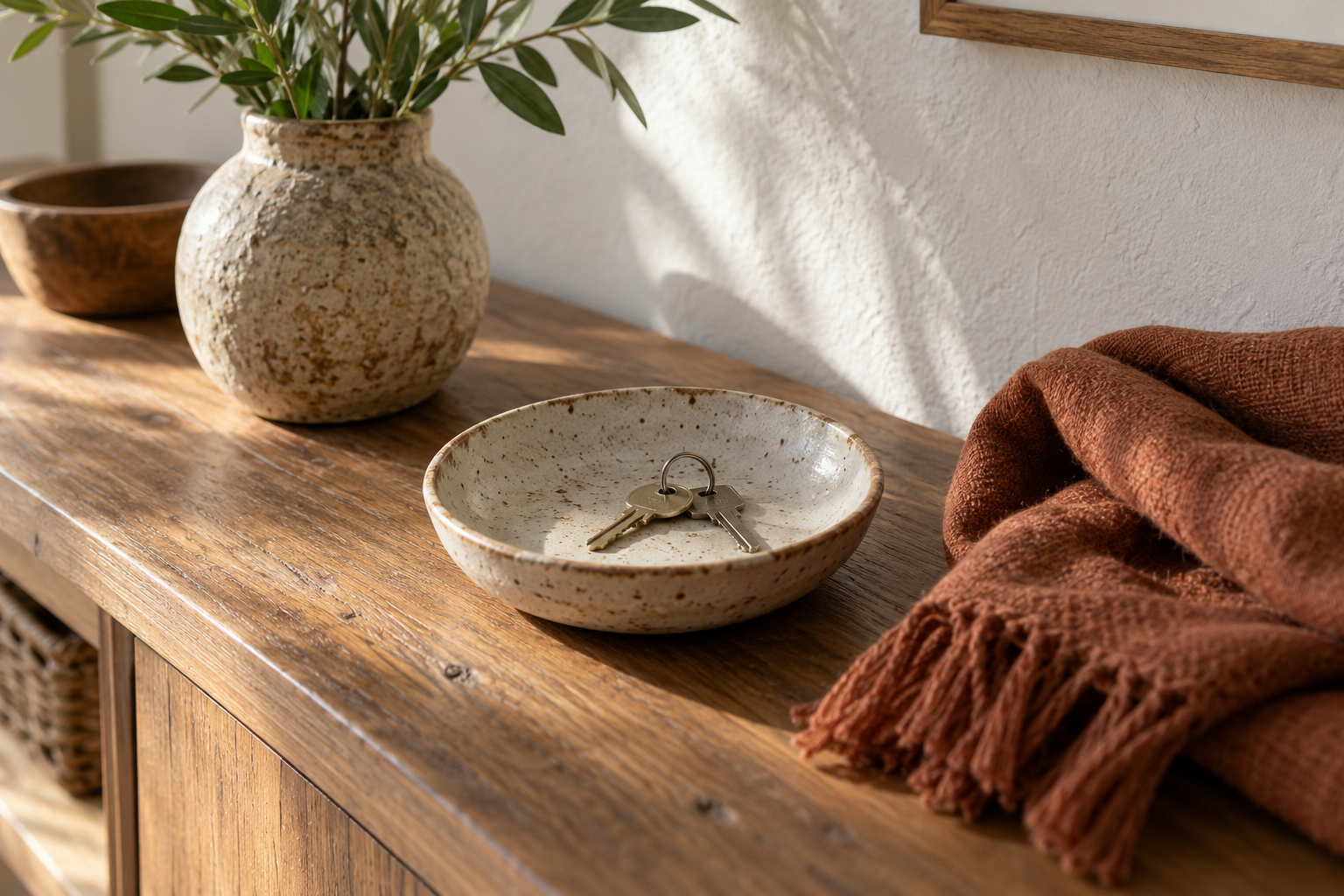
Some objects never seem to be properly lost. The keys are somewhere nearby. The glasses were just in your hand. A cable has moved from the sofa to the kitchen and then to a location nobody can explain. These are small belongings with busy lives, and a household can spend a surprising amount of attention following them around.
Giving an object a home is useful only if that home fits the way the object travels. A drawer in a distant room may be an excellent storage place in theory and a poor place to return something several times a day. Start by watching where things already land. The untidy patch on the console may be showing you the right location, even if it has not yet become a workable arrangement.
Follow the route, not the category
Consider the things you touch when entering the house, settling on the sofa, getting dressed, or going to bed. Those moments create natural stopping points. Keys arrive near the door because that is where they finish a job. Reading glasses land beside the chair because you take them off there. The locations have a practical logic worth respecting.
Choose one repeatedly misplaced object. Trace its last few movements as accurately as you can. Does it move between rooms, or simply disappear beneath other objects on one surface? A roaming object may need a deliberate return point. An object buried in a pile may only need a little separation from its neighbors. These are different problems, and they do not call for the same container.
Try locating the return point close to the moment of putting the object down. That can mean moving a dish closer to the door or putting a cable in the drawer beside the chair rather than in a box upstairs. The arrangement should make the intended action the easy action. A storage system that demands an extra trip every time is likely to remain an admirable idea.
Choose the smallest helpful boundary
A shallow tray can turn an undefined surface into a recognizable place. A hook can give a bag an obvious destination. A little open box can separate charging cables from the rest of a drawer. The boundary need not be decorative or purpose-built. It only has to make the object’s location clear and let you put it there without fuss.
Depth matters. A deep container can hide small belongings underneath larger ones. For things you need to see quickly, a shallow space may be better. If you must empty a basket to find the item you reach for each morning, consider whether the basket is gathering too many different kinds of objects. Dividing the contents by use may solve more than buying a bigger basket.
Do not assign every small item its own elaborate compartment. A little looseness makes the system easier to use. Glasses and their case can share a place. A bag can hold the things that always leave the house inside it. The useful distinction is between a clear group and a miscellaneous pile, not between perfectly separated objects and every other arrangement.
Make temporary belongings visibly temporary
A parcel waiting to be returned, a borrowed book, and a birthday card that needs posting are not permanent residents. They need an onward destination. Give those things a short-term landing place near the route they will take out of the house. Keep it distinct from the objects you expect to find there every day.
A temporary place works best when it contains an action you can recognize. A bag by the door might hold items for the next trip to a particular place. A small folder might contain papers awaiting one decision. Avoid labeling something “sort later” without identifying what sorting will involve. That phrase can turn a landing place into a waiting room with no appointments.
When the temporary spot fills, look at its contents rather than expanding it. Some items may need an actual decision, a different destination, or a date on the calendar. A larger container will hold more unresolved tasks but will not necessarily make any of them easier to complete. The physical boundary is useful partly because it tells you when attention is needed.
Give shared objects a shared explanation
A household system cannot depend on one person remembering its private logic. Show others where important shared things belong and explain the placement in plain terms. “Spare chargers are in this drawer” is enough. An extensive labeling scheme may be unnecessary if the drawer contains only a few recognizable objects.
If the arrangement does not work for someone else, ask what makes it awkward. A high hook may be unreachable. A lidded box may create an annoying extra step. A place that feels obvious from one route through the room may be hidden from another. Adapt the system to actual use rather than treating departures from it as failures of consideration.
Personal belongings may need personal places. Several sets of keys in one small dish can create confusion, while two dishes or separate hooks make the choice obvious. There is no need to standardize every person’s setup. The shared agreement is that each object can be found and the room remains usable.
Leave surfaces a little unfinished
Not every object needs an immediate journey to its final storage. A book you are currently reading can remain beside the chair. A scarf you will wear again tomorrow can sit on a convenient hook. A lived-in home includes things in progress. The goal is to make their presence understandable rather than to make all activity invisible.
This is especially useful when arranging a practical entryway. Everyday shoes and a bag are evidence of a household arriving and leaving. They become a problem when they block the route or hide something else, not merely because they can be seen.
After trying a landing place for a while, notice whether your hand starts returning the object there naturally. If it does, the arrangement is doing its job. If the object keeps landing somewhere else, move the dish, hook, or box toward that repeated choice. The reward is modest and concrete: you can pick up your keys, find your glasses, and spend a little less of the day retracing your own steps.