The pantry in a photograph often tells you very little about dinner. There may be immaculate jars, a satisfying line of baskets, and ingredients nobody in your household has ever wanted to cook. A useful pantry has a different kind of order. It reflects repeated meals, familiar tastes, and the amount of cupboard space you actually have.
It can be a single shelf. It can include packets in their original packaging, a few sturdy jars, and one slightly awkward bag that does not fit neatly anywhere. The measure is whether opening the door helps you see a meal. Building that kind of pantry begins with attention to what leaves it, rather than a list of things an accomplished cook is supposedly expected to own.
Start with the meals that return
Write down several dinners or lunches you genuinely make. Be specific enough to name their repeating ingredients. If pasta appears often, what usually goes with it? If you enjoy bowls of rice, what sauces or toppings tend to appear? The aim is not to create a definitive household menu. It is to notice the small collection of ingredients already doing most of the work.
Now look in the cupboard. You may find that the things you reach for are crowded behind ingredients bought for a single recipe. Bring the familiar items forward. Set the one-time purchases together temporarily so you can see them clearly. This is an inventory, not a verdict on past shopping. An interesting ingredient can still be worth trying, but it should not obscure the rice you cook every week.
Consider frequency and quantity separately. You might use a spice regularly but only in small amounts, while a staple disappears quickly. Buying the largest package of both does not necessarily suit your cooking. Choose quantities that fit the shelf and the rate at which you use them, without treating a fully stocked cupboard as an achievement in itself.
Give ingredients useful neighbors
There are several reasonable ways to organize a pantry. Grouping by type puts grains together and baking supplies together. Grouping by meal puts the ingredients for a familiar dinner near each other. A mixture often feels natural: a broad area for everyday staples, a compact group for baking, and a small place for things you are still experimenting with.
Try arranging a shelf around the way your hand moves when you cook. The ingredients used most often can sit toward the front, with less frequent items farther back. A container should be easy to remove without dismantling the shelf around it. If you must lift three jars to reach a fourth every evening, the arrangement may be attractive but it is asking for revision.
Avoid hiding everything inside opaque bins merely to make the cupboard look uniform. A basket is useful when it gathers small packets that would otherwise fall over. It is less useful when it conceals ingredients you forget exist. Give each container a purpose you can describe. “The little packets for baking” is a purpose; “the things that did not match the jars” is a warning that appearance may be leading the decisions.
Keep the information attached
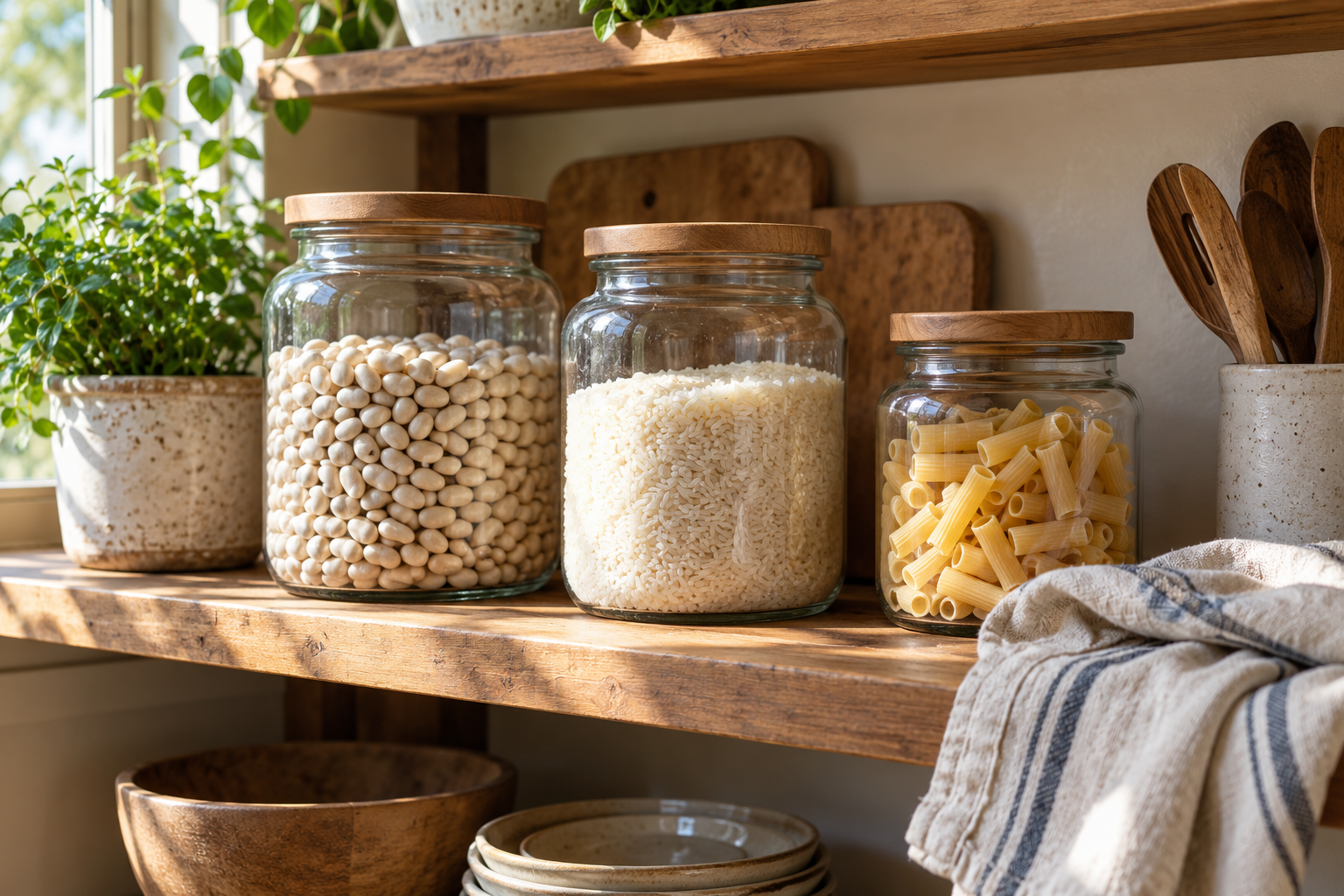
Decanting is optional. A jar can make a frequently used ingredient easier to scoop and return to the shelf, but transferring every purchase creates another household job. Keep original packaging where it works. When you do transfer something, retain the product information and any instructions you may need rather than assuming you will remember which ingredient is which.
A container also needs to suit the act of cooking. A narrow opening can make a scoop awkward. A huge jar may be heavy to lift from an upper shelf. Before buying a collection, try one container with an ingredient you use often. See whether it is comfortable to handle and whether the amount you normally buy fits without leaving an extra half-bag somewhere else.
Uniformity is not essential for legibility. You can recognize a group of different jars and packets if they have clear places. It is usually more helpful to see the amount remaining than to make every lid identical. Let the cupboard look like the kitchen it belongs to, rather than an independent display demanding its own maintenance.
Shop for a next meal, not an imagined cook
An unfamiliar ingredient is easier to welcome when it has an immediate destination. Choose one recipe or meal where you intend to use it. If the ingredient comes in a quantity larger than you need, think of another ordinary use before buying. You do not need a month of meal plans, just a plausible second appearance.
For familiar staples, a brief shopping note can be enough. Add something when you notice it getting low rather than relying on memory in the shop. Make the note wherever you will actually see it: a paper list near the cupboard or a simple note on your phone. The method matters less than being able to trust that the list includes the pasta you reached for yesterday.
A pantry is particularly useful when it gives you a starting point for a less rushed weeknight dinner. That does not mean every meal must come from storage. It means you can begin with a familiar base and choose the rest without reconsidering the whole evening from nothing.
Let the shelves change with you
Once in a while, look at the ingredients that have stopped moving. Perhaps a once-favorite meal has left the rotation. Perhaps you bought something for guests and never found another occasion. Make a deliberate choice about each item according to its packaging information and your household’s needs. Leaving it permanently at the back does not preserve the original intention.
There is room for curiosity, too. Keep a small amount of shelf space for something you want to learn to use. That makes experimentation visible and bounded. The rest of the pantry can continue doing its ordinary work. Over time, an experiment may become a staple, and a former staple may quietly disappear. A pantry you actually use is allowed to have that history: recognizable, a little uneven, and ready to help with the next meal.