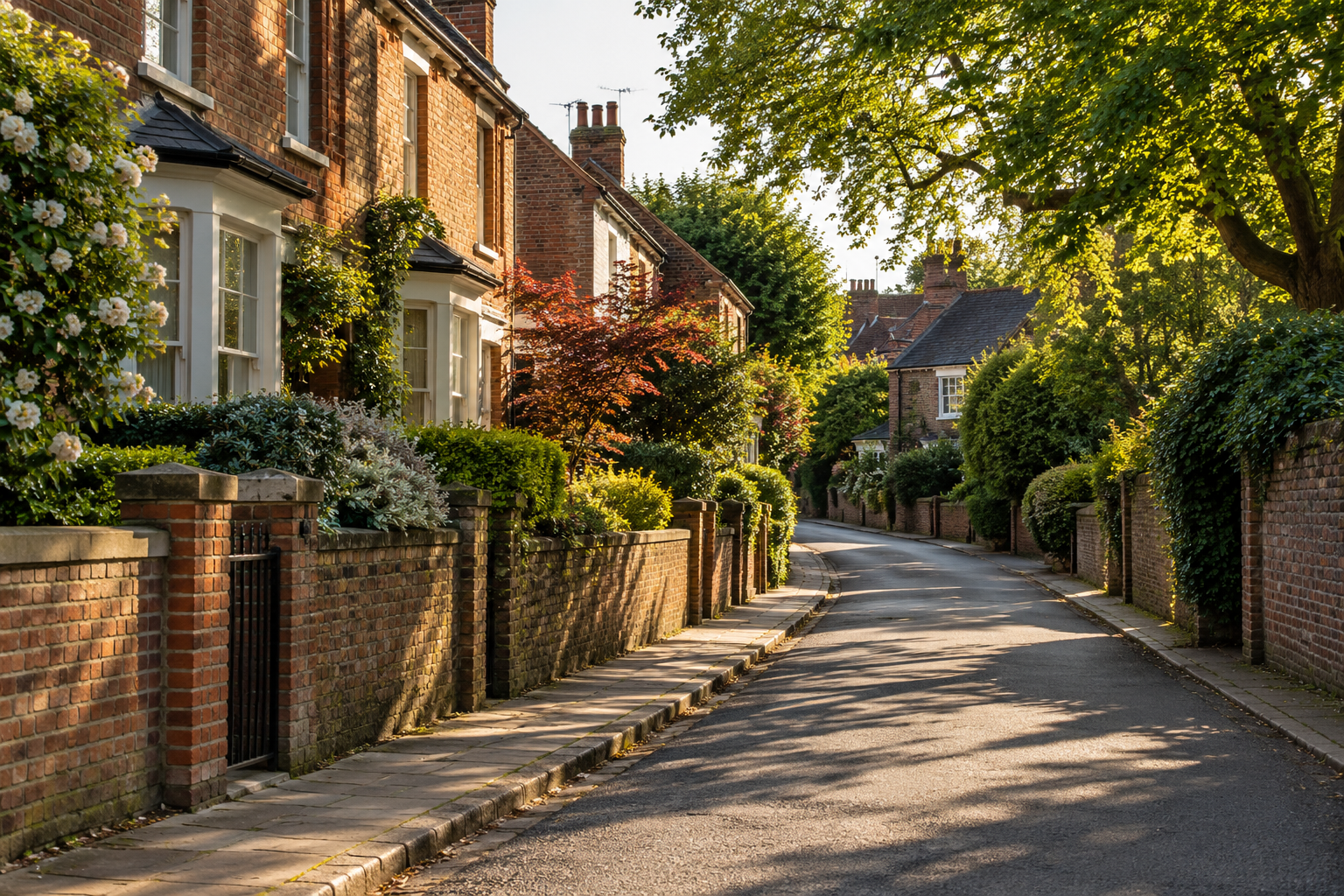
The route nearest home can become almost invisible through familiarity. You know which corner comes next, where the pavement narrows, and which turn leads back. That predictability is useful when you are going somewhere. On a walk with no particular errand, it also gives you room to notice what usually slips past.
You do not need a picturesque district or a long afternoon. Begin with a route that fits the time and mobility you have. A short outing around a block, a roll along a level path, or a few minutes in a shared courtyard can all offer material. The experiment is in how you look, not in how far you manage to travel.
Give the walk one small question
Choose something visible to follow loosely. Where does the afternoon light land? How many different shapes of gate appear? Which windows have plants? A single question provides a starting point without turning the walk into an inventory. You can abandon it as soon as something else becomes more interesting.
Look for a category broad enough to offer variety. Circles might include a bicycle wheel, a drain cover, a round window, and a coil of hose. Red might appear on a door, a leaf, a piece of outdoor furniture. The examples need no particular significance. They simply invite you to look beyond the route’s familiar outline.
Avoid making the question dependent on entering private space, approaching animals, or photographing people. There is plenty to notice from a public path. A walk becomes less pleasant when curiosity asks someone else to give up their privacy. Observe the street as a shared environment, with the same courtesy you would want outside your own home.
Change one part of a familiar route
Walking the same loop in the other direction can rearrange the view. A wall normally seen from one end suddenly frames a doorway. A slope feels different on the way down. The change is small enough to remain convenient but enough to interrupt the assumption that you already know everything along the way.
You might also turn back earlier, take a parallel street, or choose a different starting point. Keep local conditions and your own comfort in mind. You do not need to pursue novelty into an inaccessible or unfamiliar place simply to make the walk count. A good route leaves you able to return easily.
Time of day can offer variation when your schedule allows. The street outside a school looks different before the gates open and after the afternoon rush. A quiet weekend morning may reveal the shapes of buildings usually hidden by parked vehicles. These are observations to explore, not promises that a particular hour will always be peaceful.
Pause where the details gather
An entire street can be difficult to take in. Choose one ordinary view and stay with it briefly. Look at the way a railing meets a wall, the different surfaces around a doorstep, or the overlap of branches against a roof. Details become easier to see when you stop trying to collect the whole neighborhood at once.
Let several senses join in where comfortable. Notice the change from smooth paving to a rougher surface, the sound of leaves or traffic, the smell of someone cooking nearby. There is no required sequence and no correct emotional response. You may simply discover that one corner is windier than the next.
Find a suitable place to pause without obstructing anyone. Move aside on a narrow path, keep crossings clear, and leave entrances usable. Looking closely is compatible with moving considerately. If the area is too busy for a stop, carry the detail with you and choose another place later.
Bring home only what you want
Some walks end with a photograph or a few notes. Others leave no record at all. If you do take pictures, choose a detail rather than trying to prove that the walk happened. A pattern of light on a wall can be more interesting than a general view that includes everything and says little about what caught your eye.
A short sentence in an everyday notebook can also preserve the observation: a blue gate with a crooked shadow, or a row of pots arranged from large to small. You do not need polished descriptive writing. A few words that make sense to you are enough to recover the moment later.
For drawing, try remembering a simple shape when you return: the curve of a bench arm or the angle of a roof. The ideas in sketching ordinary things apply as well to neighborhood details as to objects on a table. The sketch can remain rough and entirely private.
Make repetition part of the interest
Returning to the same route is not a failure of imagination. It makes small changes easier to recognize. A planter moves, a branch loses its leaves, a fence gets repaired. Some features stay exactly as they were. The combination gives a familiar walk its particular character without requiring constant novelty.
If you like, revisit one view occasionally. Choose a tree visible from the path, an open corner, or the outline of roofs. You do not need a formal schedule or a series of matching photographs. Simply noticing the same place more than once can make the route feel more specific and less like the space between destinations.
There will also be walks when nothing catches your attention. You may be thinking about dinner, listening to a companion, or eager to get home. Let those outings be ordinary. Fresh eyes are an invitation you can accept sometimes, not a standard you must meet every time you leave the door.
Finish when the route has served the time you wanted to give it. There is no prize for extending a pleasant short walk until it becomes inconvenient. The street will be there again, with its gates, shadows, uneven lines, and quietly changing details. You can look a little differently next time.